
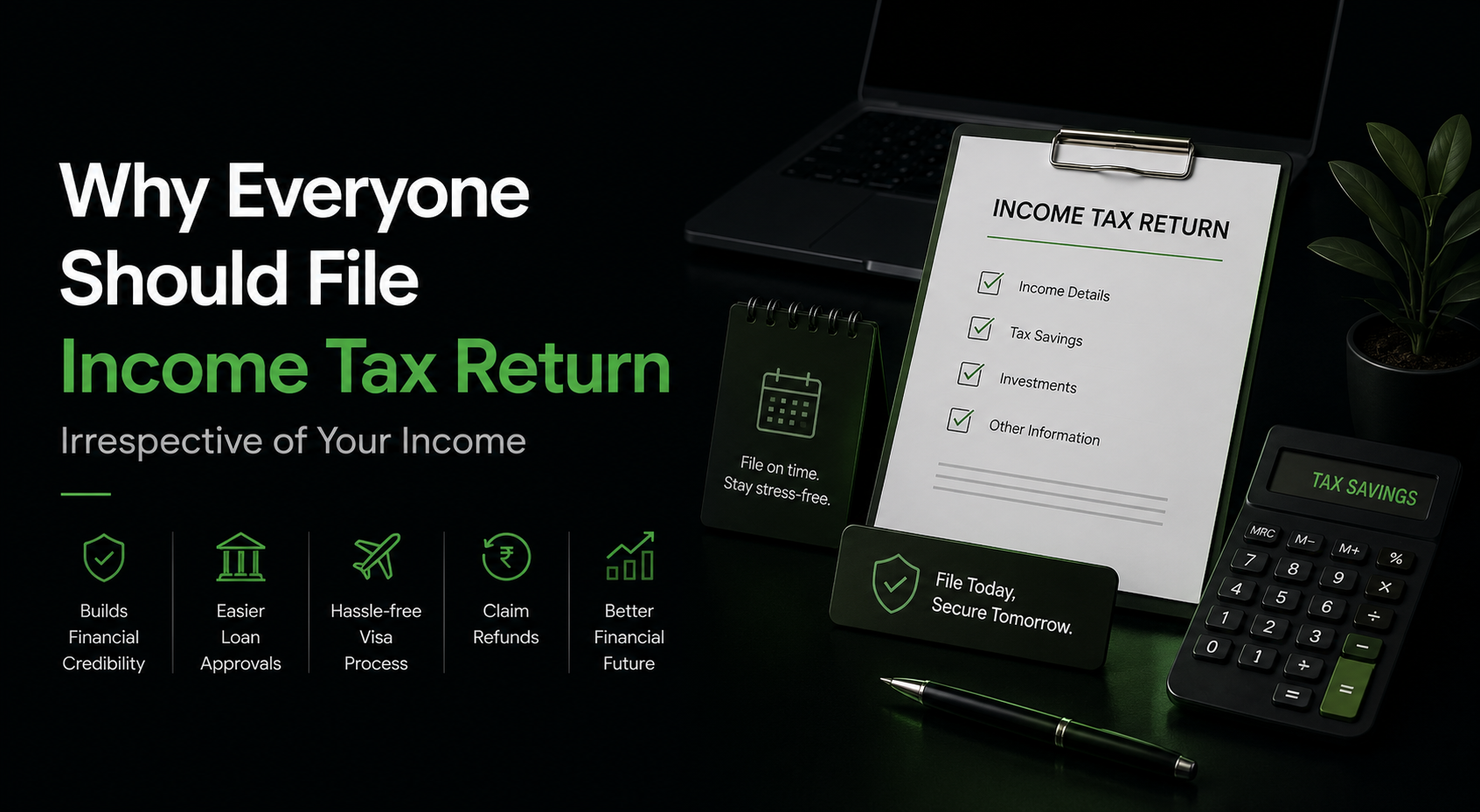
Why Everyone Should File an Income Tax Return (ITR), Regardless of Their Income
Many people believe that filing an Income Tax Return (ITR) is only necessary if they earn above the taxable income limit. However, that’s one of the biggest misconceptions about taxes.
In reality, filing an ITR offers several financial, legal, and practical benefits—even if you don’t owe any tax. Whether you’re a student, freelancer, salaried employee, homemaker, retiree, or small business owner, filing an ITR can strengthen your financial profile and make future financial transactions much smoother.
In this blog, we’ll explain why everyone should consider filing an Income Tax Return, irrespective of their income.
What Is an Income Tax Return (ITR)?
An Income Tax Return (ITR) is a form submitted to the Income Tax Department that reports your income, deductions, taxes paid, and other financial details for a financial year.
Even if your taxable income is below the exemption limit, filing an ITR creates an official record of your income and financial status.
Is Filing an ITR Mandatory for Everyone?
No. Filing an ITR is mandatory only in specific situations prescribed under the Income-tax Act, such as when your income exceeds the basic exemption limit or when certain other conditions apply.
However, voluntary filing is allowed and is often beneficial even when you are not legally required to file.
10 Reasons Why Everyone Should File an Income Tax Return
1. Builds Financial Credibility
An ITR serves as proof of your income and financial discipline.
Banks, financial institutions, landlords, and even some employers may ask for your ITR to assess your financial standing.
A regular filing history demonstrates responsible financial behavior.
2. Makes Loan Approvals Easier
Planning to apply for a:
- Home loan
- Personal loan
- Education loan
- Business loan
- Car loan
Most banks ask for 2–3 years of ITRs while evaluating your loan application.
Without ITRs, proving your income can become more difficult, especially for:
- Freelancers
- Self-employed professionals
- Consultants
- Small business owners
3. Helps During Visa Applications
Many countries request income-related documents during visa processing.
ITRs act as reliable evidence that you have:
- Stable income
- Financial capacity
- Strong ties to your home country
This can strengthen applications for tourist, student, and business visas.
4. Claim Income Tax Refunds
If tax has been deducted at source (TDS) from your salary, bank interest, or other income and your actual tax liability is lower or nil, filing an ITR is the only way to claim the refund.
Without filing your return, excess tax deducted may remain unclaimed.
5. Carry Forward Capital Losses
Investors who incur losses in:
- Stocks
- Mutual Funds
- Real Estate
- Other capital assets
can generally carry forward eligible losses to offset future gains, subject to the applicable provisions and timelines under the Income-tax Act.
Timely filing is essential to avail this benefit.
6. Proof of Income for Various Purposes
An ITR is widely accepted as an official proof of income for:
- Passport applications (where required)
- Scholarship applications
- Government tenders
- Rental agreements
- Financial documentation
- Higher education abroad
7. Helps Self-Employed Professionals
If you’re a:
- Freelancer
- Content creator
- YouTuber
- Consultant
- Designer
- Influencer
- Small business owner
your ITR becomes one of the strongest documents proving your income, especially when salary slips are unavailable.
8. Maintains a Clean Financial Record
Even if you have little or no taxable income today, maintaining a consistent ITR filing history creates a transparent financial record that may prove useful in the future.
This continuity can simplify financial verification processes later in life.
9. Avoid Future Tax Issues
If the Income Tax Department seeks clarification about high-value financial transactions or notices discrepancies, a filed ITR provides documented evidence of your reported income and taxes.
Maintaining regular compliance can make responding to such situations easier.
10. Encourages Better Financial Planning
Preparing an ITR helps you review your:
- Income sources
- Investments
- Deductions
- Tax-saving opportunities
- Financial goals
This annual review promotes more informed financial planning and disciplined money management.
Who Should Consider Filing an ITR Even If It Isn’t Mandatory?
Voluntary filing can be beneficial for:
- Students with internship income
- Freelancers and gig workers
- First-time salaried employees
- Small business owners
- Homemakers earning interest income
- Senior citizens
- Investors
- Professionals with irregular income
- Individuals planning to apply for loans or visas
Common Myths About Filing ITR
Myth 1: “I don’t earn enough, so I don’t need to file.”
While you may not be legally required to file, doing so voluntarily can provide several long-term benefits.
Myth 2: “Only salaried people should file returns.”
False.
Freelancers, consultants, business owners, and investors can also benefit significantly from maintaining an ITR history.
Myth 3: “Filing ITR means I have to pay tax.”
Not necessarily.
You may have zero tax liability and still file your return.
Myth 4: “ITR filing is only useful during tax season.”
An ITR often serves as an important financial document throughout the year—for loans, visas, investments, and other financial applications.
Benefits of Filing an ITR at a Glance
| Benefit | Why It Matters |
|---|---|
| Financial credibility | Demonstrates financial responsibility |
| Loan applications | Helps verify income for lenders |
| Visa processing | Supports financial documentation |
| Tax refunds | Enables refund claims where applicable |
| Capital loss carry forward | May reduce future tax liability |
| Income proof | Useful for multiple financial purposes |
| Compliance | Maintains a transparent financial record |
| Financial planning | Encourages better money management |
Income Tax Return (ITR) Filing Deadline 2026: Important Dates You Should Know
Filing your Income Tax Return on time helps you avoid penalties, interest, and unnecessary complications.
For Financial Year (FY) 2025–26 / Assessment Year (AY) 2026–27, the important deadlines are:
| Category | Due Date |
|---|---|
| Salaried individuals & taxpayers filing ITR-1 or ITR-2 | 31 July 2026 |
| Business & professionals (non-audit cases) filing ITR-3 or ITR-4 | 31 August 2026 |
| Taxpayers requiring audit | 31 October 2026 |
| Belated Return | 31 December 2026 |
As of 31 July 2026, the government has not announced any extension to the filing deadline for most individual taxpayers.
When Is the Ideal Time to File Your ITR?
While many taxpayers wait until the last few days, the best practice is to file your ITR as soon as all your tax documents are available.
Ideally, you should file your return:
- Within May to June, after receiving your Form 16 and ensuring your Annual Information Statement (AIS) and Form 26AS are updated.
- At least 2–3 weeks before the due date to avoid last-minute portal issues and errors.
- Early filing also means faster processing of refunds and more time to revise your return if you discover any mistakes.
What Happens If You Miss the ITR Filing Deadline?
Missing the due date doesn’t necessarily mean you can’t file your return, but it can have financial consequences.
1. Late Filing Fee
If you file a belated return, you may have to pay:
- Up to ₹5,000 if your total income exceeds ₹5 lakh.
- Up to ₹1,000 if your total income is ₹5 lakh or below.
2. Interest on Outstanding Tax
If any tax remains unpaid, interest may also be charged under the applicable provisions of the Income-tax Act until the tax is paid.
3. Delay in Tax Refund
If you’re eligible for a refund, filing late may delay the processing and receipt of your refund.
4. Loss of Certain Tax Benefits
Filing after the due date may prevent you from carrying forward certain losses, such as eligible capital losses or business losses, to future years.
5. Increased Risk of Notices
While a late return does not automatically trigger a tax notice, timely filing helps maintain compliance and reduces the likelihood of avoidable follow-up from the Income Tax Department.
Final Thoughts
Filing an Income Tax Return is more than just a legal obligation – it’s an important part of building a strong financial foundation. Even if your income falls below the taxable limit, voluntarily filing an ITR can help you establish financial credibility, claim eligible refunds, support loan and visa applications, and maintain a clear record of your income.
As your career and financial goals evolve, having a consistent ITR filing history can save time, simplify documentation, and open up more opportunities. Filing your return each year is a small step that can